
Performance Training: How It Builds Strength, Fitness and Athletic Performance
You lift three times a week, but your strength progress has plateaued. You have also noticed that your left hip feels restricted or uncomfortable during deep squats.The current programme you follow may be building strength, but you are not sure whether it is addressing your movement, mobility and conditioning needs.
Performance training is an individualized approach that combines strength training, movement quality and conditioning together according to your goals, training history and assessment findings. It aims to develop your physical qualities to produce strength, movement control and the ability to sustain or repeat effort.
What performance training involves
Performance training has four working parts. Each one of them has a purpose for your body.
Strength
Compound exercises such as squats, hinges, presses and pulls can form the foundation of a programme because they train several muscle groups and joints together. Exercise selection should still reflect the individual’s goals, ability and the demands of the activities they want to perform.
Movement quality
Mobility work and movement coaching can be included alongside strength exercises. The aim is to improve control and build strength within the individual’s range of motion.
Conditioning
Progressive conditioning aims to improve your ability to sustain and repeat effort while maintaining appropriate technique as fatigue builds.
Power, speed and agility
Power describes how quickly you can produce force. Speed concerns how quickly you move, while agility involves responding to a stimulus and changing direction. These qualities can be developed when relevant to your goals and training readiness.
RAPIDÉ’s performance training programme is designed around consultation, relevant movement and capacity findings, planned progression and scheduled review.
What performance training builds?
The World Health Organization recommends that adults complete at least 150 minutes of moderate-intensity aerobic activity, or 75 minutes of vigorous-intensity activity, each week, alongside muscle-strengthening activities involving major muscle groups on at least two days a week.
A structured programme can help some people organise their activity and strength work around these recommendations.
Usable strength
Strength can support everyday tasks such as carrying objects, climbing stairs and playing sport. However, transfer depends on the task and the way strength is trained. A programme may combine foundational lifts with practice of movements, speeds and demands relevant to the person’s goals.
Movement control
Strength training through a comfortable, controlled range can help develop strength and control within that range. The useful range differs between individuals and activities. At RAPIDÉ, mobility and strength work can be combined where the assessment and goals call for it.
Work capacity
For a runneror squash player, work capacity can influence the ability to sustain repeated efforts during training or competition. For someone with a demanding work schedule, general fitness may support daily activity, although performance during a long workday also depends on sleep, stress, health and other factors.
Injury Prevention Limit
Training cannot guarantee injury prevention. A structured programme can identify relevant areas for development, such as strength, movement control or conditioning, and progressively train these qualities. If assessment raises concerns about pain or a possible injury, referral to a qualified healthcare professional may be appropriate.
Sports performance training for athletes and everyday movers
Sports performance training sequences strength, speed, agility and power around the sport, the athlete’s training history and the competition calendar. Alongside structured training, athlete recovery also plays an important role in managing training demands and maintaining consistency.
The same approach serves five kinds of client:
Athletes: sport-specific strength, power, speed and conditioning, scheduled around training and competition load.
Active professionals: a structured progression for people who train between meetings and want a plan built around their own movement.
Beginners: technique is coached before load, at a pace suited to your current ability.
People returning to activity: gradual rebuilding of strength and confidence, coordinated with physiotherapy where relevant.
Longevity-focused clients: training aimed at sustained strength, mobility and independence over years.
Exercises a performance training programme can include
Your assessment decides the exact selection. These examples show the main categories and what each one develops.
| Quality | Example exercises | What it develops |
| Strength | Squat, deadlift, split squat, push-up, overhead press, row, pull-up | Force through the hips, knees, shoulders and trunk |
| Mobility and movement control | Paused goblet squat, Cossack squat, controlledthoracic rotation | Usable range at the hip, ankle and upper back |
| Balance and coordination | Single-leg Romanian deadlift, step-up, lateral lunge | Stability and efficient movement |
| Power | Box jump, medicine ball throw, kettlebell swing | The speed at which you produce force |
| Speed and agility | Short sprints, shuttle runs, change-of-direction drills | Acceleration, deceleration and turning |
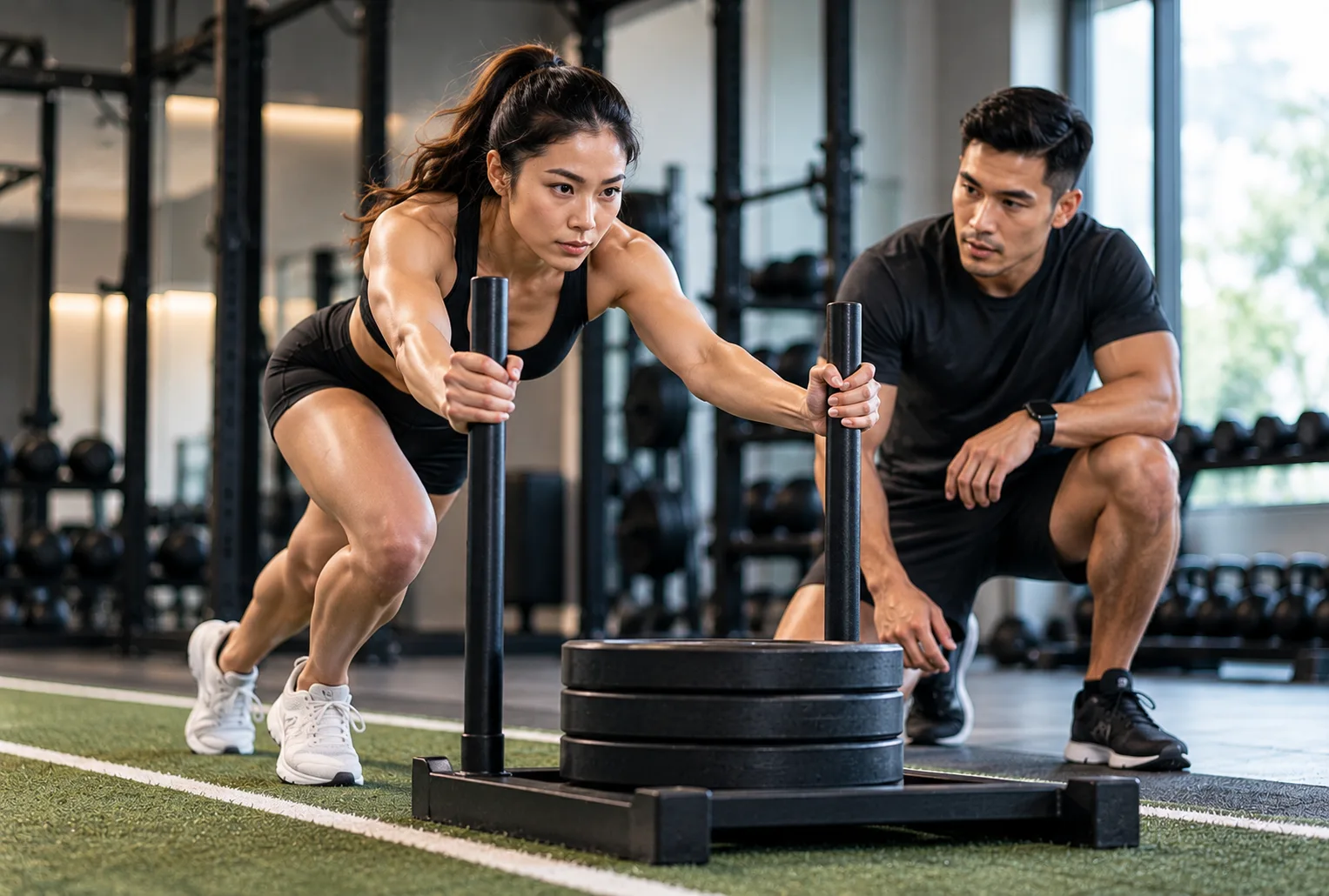
| Conditioning | Rowing or bike intervals, sled push, loaded carries | The ability to sustain and repeat effort |
Every exercise scales. A beginner may squat to a box with bodyweight. An athlete may add load, tempo or a jump variation.
How to Practise?
Learn an unfamiliar movement with a manageable load and a level of complexity suited to your experience. Increase load, speed or complexity gradually when you can perform the exercise with appropriate technique.
Rest enough between sets to support the intended training quality.
How a RAPIDÉ performance training programme is built:
- Consultation: We discuss your goals, training history and current level ofactivity.
- Movement assessment: We review relevant movementpatterns and physical qualities, such as mobility, strength, balance and coordination, in relation to your goals
- Programme design: Exercises and progression are selected from your findings.
- Training: Structured sessionswith load and complexity raised as your capacity allows.
- Review: The programme is adjusted as your capacity and goals change.
Start with an assessment
Performance training works best when the first step is understanding how you move. Whether your goal is a sports season, a first pull-up or strength that lasts into your seventies, the assessment sets your starting point.
Book your initial assessment with RAPIDÉ.
Frequently asked questions
Performance training is a structured approach that builds strength, movement quality and conditioning together. Your assessment and goals help determine the focus and pace of the programme. The aim is to build usable physical capacity: producing force, controlling movement through an appropriate range of motion and sustaining effort over time. Athletes, active professionals and people building long-term physical fitness can all benefit from this approach, with training adapted to their individual needs.
Typical exercises include squats, hinges, presses, pulls, carries, jumps, sprints and conditioning intervals. Your programme is designed around your goals, experience and current ability, with each exercise scaled to an appropriate level. A beginner may start with bodyweight squats to a box, while an athlete may progress to loaded or explosive variations. The exercise table above provides examples of how different exercises develop specific physical qualities.
Yes. Beginners can start with a programme adapted to their current ability and experience. Exercises are introduced at an appropriate level, with coaching to help develop technique, coordination and confidence before progressing the intensity or complexity. The consultation and assessment provide the programme a clear starting point to build from.
Strength, power, speed and conditioning contribute performance across many sports. Performance training helps develop these physical qualities as part of a broader sport-specific programme. Each sport has different demands, such as repeated sprints in football or rotational power in racquet sports. Training should therefore be adapted to the athlete’s sport, position, individual needs and competition schedule. Sport-specific skills and practice remain essential.
Strength and conditioning develops physical qualities such as strength, power, speed and endurance. Sports performance training applies these qualities to the specific demands of a sport, taking into account factors such as movement patterns, playing position and competition schedule. The two approaches often overlap, with strength and conditioning forming an important part of a wider sports performance programme.
The two overlap, but each describes. Personal training refers to a coaching format where a trainer works with you one-on-one. Performance training describes an approach to developing physical capabilities through assessment, structured programming, and progressive training across strength, movement quality and conditioning, and scheduled reviews. A personal training programme can incorporate performance training principles, and performance training can be delivered in different coaching formats.
Strength training through a controlled range of motion can help improve strength and control within that range. Exercises such as paused goblet squats and Cossack squats can challenge strength and control in deeper or more demanding positions. However, improvements in mobility depend on several factors, including joint structure, tissue tolerance, strength and movement coordination. An assessment can help identify areas that may benefit from targeted training.
The timeline depends on your starting point, training history and consistency. Early changes frequently come from better coordination and technique, while strength and conditioning gains build over a longer period. Your regular reviews track progress and identify when your programme needs to be adjusted.
Book your Performance Training session at RAPIDÉ
Reference
Currier BS, D’Souza AC, Singh MAF, Lowisz CV, Rawson ES, Schoenfeld BJ, Smith-Ryan AE, Steen JP, Thomas GA, Triplett NT, Washington TA, Werner TJ, Phillips SM. American College of Sports Medicine Position Stand. Resistance Training Prescription for Muscle Function, Hypertrophy, and Physical Performance in Healthy Adults: An Overview of Reviews. Med Sci Sports Exerc. 2026 Apr 1;58(4):851-872. doi: 10.1249/MSS.0000000000003897. Epub 2026 Mar 5. PMID: 41843416; PMCID: PMC12965823.
https://pmc.ncbi.nlm.nih.gov/articles/PMC12965823/
