
Cold Exposure and Metabolic Health: What the Physiology Actually Shows
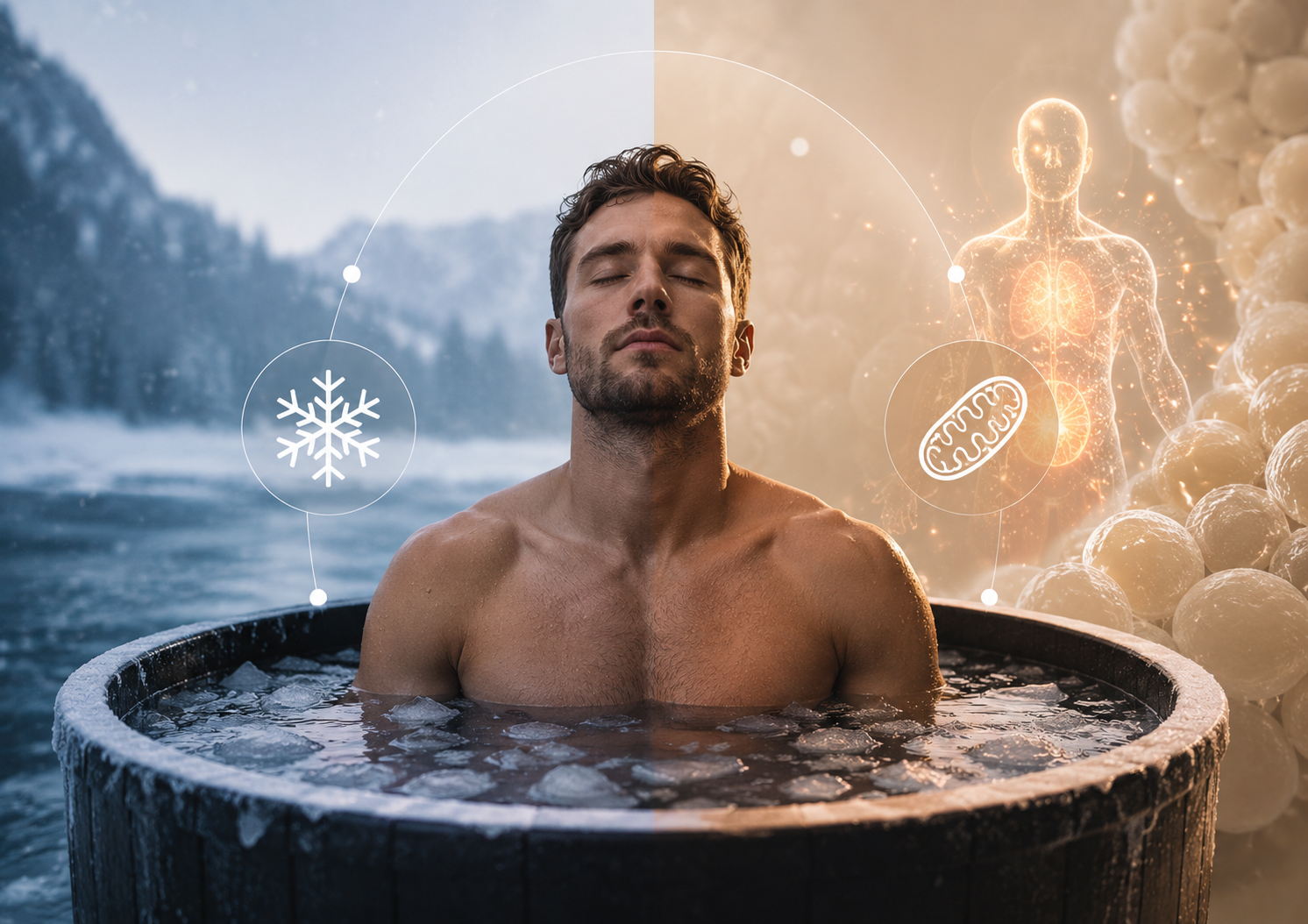
When you step into cold water, your body is doing something precise: activating a sympathetic nervous system response measured in norepinephrine release and mitochondrial uncoupling. That distinction, between spectacle and physiology, is where a genuine conversation about cold exposure and metabolic health begins.
In Singapore, where the closest most people come to cold is an overcooled office, cold exposure has to be introduced deliberately. It is not a climate you fall into. It is a protocol you choose, calibrated to a purpose. And the purpose worth examining here is metabolic: what cold does inside the body, and where the evidence stops.
What Happens to the Body During Cold Exposure?
Cold exposure triggers an immediate, measurable cascade. Skin thermoreceptors detect the drop in temperature and signal the sympathetic nervous system, which releases norepinephrine. This is not a vague “stress response.” It is a specific neurochemical trigger with two consequences worth understanding.
First, norepinephrine drives vasoconstriction: blood vessels near the skin narrow, redirecting circulation toward the body’s core to preserve internal temperature. Second, in tissues equipped for it, norepinephrine binds to beta-adrenergic receptors and initiates thermogenesis, the metabolic generation of heat through increased energy expenditure.
This is the physiological basis for cold-induced thermogenesis. The body is not simply enduring the cold. It is spending measurable energy to counteract it.
Can Cold Exposure Influence Brown Fat Activity?
Brown adipose tissue (BAT) is metabolically distinct from the white fat most people associate with energy storage. BAT is dense with mitochondria and expresses a protein called UCP1 (uncoupling protein 1), which allows it to convert stored energy directly into heat rather than ATP. Cold exposure activates this tissue through the same norepinephrine pathway described above: sympathetic stimulation triggers beta-adrenergic signalling, which switches on UCP1-dependent thermogenesis within brown fat cells.
What this means in practical terms: cold exposure does not simply make you feel alert. It engages a tissue whose specific biological function is energy expenditure through heat production.
What it does not mean is that brown fat activation is a shortcut to significant fat loss or a substitute for training and nutrition. A systematic review and meta-analysis published in Frontiers in Physiology examined the effect of acute cold exposure on BAT activity and energy metabolism in humans and found the results across studies to be inconsistent, shaped by differences in cooling protocol, individual BAT prevalence, and measurement method. The mechanism is real. Its magnitude, for any individual, is not something a wellness claim can responsibly quantify without direct measurement.
This is precisely why RAPIDÉ treats cold exposure as one calibrated input within a broader recovery protocol, not a headline intervention.
How Does Cold Exposure Fit Into Metabolic Recovery After Exercise?
Metabolic recovery after exercise is not a single event. It is a window, typically extending for hours after training, during which the body repairs tissue, clears metabolic byproducts, and restores hormonal balance. Cold plunge therapy intersects with this recovery window in two ways. Unlike general cold exposure, a structured cold plunge protocol allows temperature and duration to be carefully controlled, improving consistency and safety.
The vasoconstriction described earlier temporarily reduces blood flow and inflammatory signalling at the tissue level. On rewarming, blood flow returns in a wave, which some practitioners describe as a flushing effect on inflammatory markers. This is a physiological pattern, not a guarantee: individual inflammatory response varies with training load, sleep, and baseline metabolic health.
This is also where measurement becomes essential rather than optional. Subjective recovery (how a person feels) and metabolic recovery (what glucose, energy expenditure, and inflammatory markers are actually doing) frequently diverge. For readers who want to understand what is happening beneath the surface of a recovery protocol, our guide to metabolic tracking and continuous glucose monitoring in Singapore explains how CGM data can clarify whether an intervention like cold exposure is producing a measurable metabolic effect for your physiology specifically, rather than a general one borrowed from a study population.
Precision, here, is the entire point. Cold exposure without measurement is a sensation. Cold exposure with measurement is a protocol.
Who Should Approach Cold Exposure With Caution?
Cold exposure is a genuine physiological stressor, and stressors are not universally appropriate. Certain cardiovascular conditions, uncontrolled hypertension, Raynaud’s phenomenon, cold urticaria, and pregnancy all warrant a conversation with a clinician before any structured cold protocol begins.
Sudden cold immersion places real, immediate demand on the cardiovascular system; that demand is precisely why unsupervised, poorly calibrated exposure carries risk that a controlled, clinician-guided protocol is designed to manage. This is not a caveat added for liability.
It is the reason RAPIDÉ builds every protocol around an individual’s measured baseline rather than a generic duration and temperature borrowed from someone else’s routine.
Frequently Asked Questions
There is no universal duration. Protocols are typically built around individual tolerance, cardiovascular baseline, and the specific outcome being targeted, whether that is recovery, alertness, or a broader metabolic health goal. Duration should be prescribed, not guessed.
Frequency depends on the individual’s recovery capacity and training load. For most people beginning a structured practice, two to three sessions per week under guidance is a reasonable starting cadence, with adjustment based on how the body responds over time.
For some individuals, yes; for others, particularly those with cardiovascular risk factors, daily exposure without clinical oversight is not advisable. This is an individual calibration, not a fixed rule.
Cold showers and controlled ice application can activate the same sympathetic and thermogenic pathways, though water immersion typically achieves more consistent, measurable cooling than a shower alone.
No. The energy expenditure associated with cold-induced thermogenesis is modest compared to structured exercise. Cold exposure functions as a complementary input to metabolic health, not a substitute for training, sleep, and nutrition.
Cold exposure is not a single decision made in a plunge pool. It is a sustained, measured practice, one variable among several that together determine whether the body’s metabolic and recovery systems are actually improving over months and years rather than simply feeling different for an afternoon.
Ready to find out whether cold exposure belongs in your protocol? Book a clinician-guided consultation with RAPIDÉ and build a recovery practice calibrated to your physiology, not a trend.
