
What Is Clinical Pilates? How It Builds Strength, Mobility and Posture
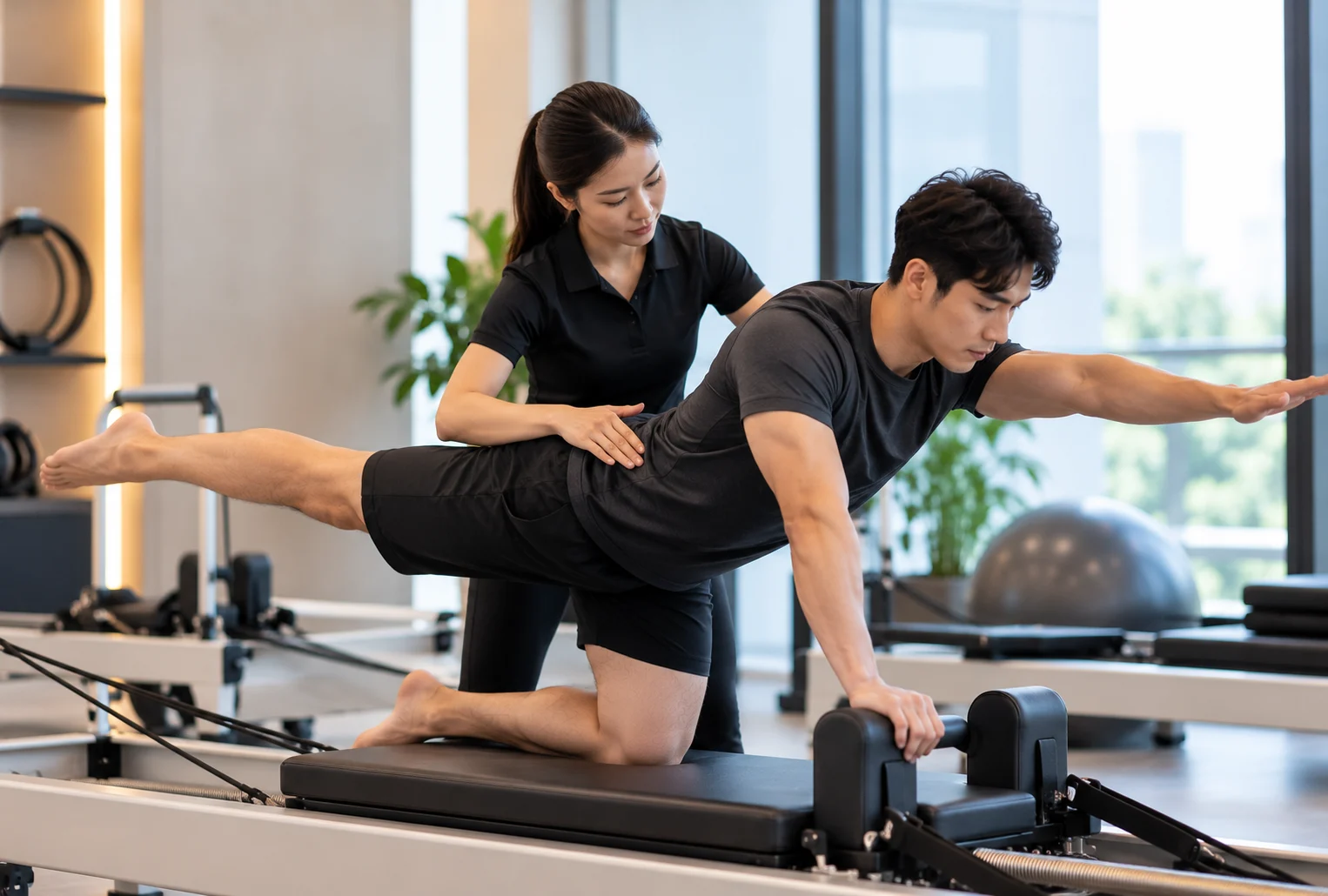
Movement is a skill that can be developed at any age. Clinical Pilates uses Pilates-based exercises on the reformer, guided by an assessment of how you move. This guide explains how the approach works, what the approach can build, and what to expect from your first session.
What is clinical Pilates?
Clinical Pilates is a form of Pilates guided by an assessment informed by physiotherapy. A clinician reviews your movement, relevant health history and goals before selecting exercises, spring resistance and progressions. On the reformer, a sliding carriage and adjustable springs allow it to be modified, supported or made more challenging to suit your body.
The reformer allows the exercises to be adjusted in several ways. Springs set the resistance that can either assist or challenge a movement, while the carriage provides a moving surface for a controlled range. This adaptability is why clinical reformer Pilates is useful for people returning to activity after an injury, as well as those looking to improve strength and movement control.
At RAPIDÉ in Singapore, physiotherapists and Pilates instructors work within the same clinical model. Your programme is guided by your assessment findings, goals and progress.
How does clinical Pilates work?
Clinical Pilates adapts several elements of each exercise to the person using the reformer. These adjustments are guided by the initial assessment and reviewed as your ability and goals change.
Exercise selection: Someone with limited upper-back mobility may begin with supported arm movements. Someone managing knee discomfort may start with modified footwork, depending on their assessment.
Spring resistance: A heavier spring may provide more support or increase resistance, depending on the exercise and setup. A lighter spring may reduce assistance and require greater control of the carriage. The appropriate setting depends on the movement and the individual’s ability.
Range of motion: You begin within a comfortable range and can gradually work towards a larger range as comfort, mobility and control allow.
Progression: Loads, positions and complexity change in planned steps.
Instructors also adjust the footbar, headrest and straps to suit your body proportions and the exercise. As a result, the same movement may look different for two clients. A group class generally follows a shared programme, while a clinical plan can be adapted to the individual.
Clinical Pilates vs Pilates
Both draw on the same family of exercises. The difference lies in how the plan is built.
| Points | Regular Pilates class | Clinical Pilates |
| Starting point | Class timetable and level | Assessment of movement, history and goals |
| Exercise plan | Often one sequence for the whole group | Selection, resistance and range set per client |
| Progression | Follows the class programme | Adjusted to your assessment as you improve |
A well-taught regular Pilates class may suit someone who wants general exercise and has no specific rehabilitation needs. Clinical Pilates may be more appropriate for people who need exercises adapted around pain, a previous injury, movement limitations or individual goals. The best starting point depends on an assessment and the instructor’s scope of practice.
Reformer Pilates
Reformer exercises can train strength, control, mobility and coordination. The benefits you experience will depend on your programme, starting point and consistency.
Core strength
The deep stabilising muscles of your trunk and pelvis hold the spine steady. Reformer exercises will challenge these muscles by loading them through slow, controlled movement. With controlled breathing and movement, you practise coordinating these muscles to support your body during exercise and everyday tasks.
Developing trunk strength and control may help you perform everyday movements with greater confidence and efficiency. The exercises should be progressed according to your ability and goals.
Clinical Pilates for mobility and flexibility
Mobility is the ability to move a joint through a range with control. Flexibility generally refers to the ability of muscles and other soft tissues to lengthen. Reformer exercises can take your joints and muscles through progressively challenging ranges, which may help improve mobility and flexibility over time.
Clinical Pilates can include exercises that develop flexibility alongside strength and control. The aim is not simply to increase range but to help you move through the range you have with greater control.
Clinical Pilates for posture
Posture is influenced by several factors, including strength, mobility, habits and the demands of daily activities. Clinical Pilates can help you practise movement control and build strength for the positions and activities that matter to you. A reformer session may address:
- Alignment and body awareness, using the carriage and instructor feedback to help you notice how you position and move.
- Movement patterns, such as how you reach, rotate and rise from a chair.
- Strength and endurance in the muscles used to maintain and change positions throughout the day.
Clinical Pilates for balance
Balance involves coordination, strength, sensory feedback and the ability to respond to changes in position. Pilates may help improve balance for some people, although outcomes vary with age, health status and programme design. Your clinician can advise whether it is suitable for your needs.
Clinical Pilates for beginners
New to the reformer? Your first will generally involve three steps.
- Initial assessment. Your movement, medical history (where relevant) and goals set the starting point.
- Personalisedprogramme.Based on your assessment, your instructor recommends a suitable starting format, such as a private one-to-one session or a small-groupclass, and adapts the exercises to your experience and needs.
- Progressive development. Sessions build in stages, and your plan changes as strength and movement improve.
Early clinical Pilates exercises may include footwork with your feet on the footbar, bridging, supported arm work with the straps and side-lying leg movements. Your instructor will select exercises based on your assessment and introduce more challenging variations as your control and strength develop.
Expect a controlled pace, deliberate breathing, and exercises that challenge coordination between your trunk and limbs. Sessions at RAPIDÉ run for 50 minutes. Wear comfortable clothing that allows free movement, along with grip socks for traction on the reformer. RAPIDÉ instructors are trained in internationally recognised methods, including STOTT Pilates and Polestar Pilates.
Rehab Pilates and clinical rehabilitation Pilates after injury
Rehabilitation-focused Pilates can help bridge the transition from physiotherapy to ongoing exercise. Clinical Pilates may carry movement and strengthening principles from your physiotherapy programme into longer-term training, supporting your approach to athlete recovery. Depending on your assessment and recovery stage, it may support:
- Returning to exercise after physiotherapy.
- Rebuilding strength after surgery, at a pace matched to your recovery stage.
- Managing recurring back pain through controlled, low-impact strengthening.
- Progressing from private sessions into small-group classes as confidence builds.
Pilates can be used to develop strength and movement control. If you have back pain, a physiotherapy assessment can help identify relevant contributing factors and guide the choice and progression of exercises.
Post-surgical clients and recent injuries often need clearance from their healthcare professional before progressing exercise intensity. If you have pain or a health concern that has not been assessed, seek appropriate clinical advice before starting. If you are otherwise well and want to build strength, improve movement or work on posture, ask the studio which session format is suitable.
Why a shared clinical model changes the handoff
RAPIDÉ describes its approach as a connected process: assessment, clinical review, personalised recommendations, guided sessions and progress review. Clinical Pilates can form part of this process alongside other approaches to recovery therapy where appropriate.
Where physiotherapy and Pilates are both part of your plan, the findings from your physiotherapy assessment can help with your Pilates programme. Progress reviews allow the programme to be adjusted as your needs and abilities change.
Other services, such as cold plunge or red light therapy, may be considered alongside Pilates where appropriate. Suitability depends on your health, goals and clinician’s recommendations; these services are not necessary for everyone.
Who benefits from clinical Pilates?
The method suits a wide range of people:
- Beginners who want proper guidance from the first session.
- People finishing physiotherapy who want to keep building strength and movement.
- People managing back discomfort or posture-related concerns who may benefit from individually adapted, low-impact exercise, following appropriate assessment.
- Active adults who want to refine movement quality and train for the long term.
Each group starts from a different point. An assessment helps determine the most suitable exercises, level of support and session format.
How often should you train?
There is no single training frequency that suits everyone. Your instructor can recommend a schedule based on your goals, current ability, health history and other physical activity. Consistency matters, but sessions should allow enough time for recovery and fit comfortably into your routine.
Private sessions can be tailored closely to your assessment and allow more individual attention. Small-group sessions may suit clients who have been assessed and placed in an appropriate class. Some people begin with private sessions before progressing to a group. If you also want to develop strength, you may be able to combine Pilates with performance training as part of a suitable programme.
Begin with an assessment
Strength, mobility and posture are habits built over years. A programme that adaptsas your ability changes can help you keep progressing. Reformer sessions may complement other activities, whether you are training for a race, returning to the gym or working towards moving more.
Clinical Pilates at RAPIDÉ starts with an assessment of your movement, goals and experience. Book a clinical reformer Pilates assessment, and the team can recommend a suitable session format and starting programme.
Frequently asked questions
A regular class typically follows a set sequence for everyone in the room. Clinical Pilates adapts exercise selection, resistance and progression to each client’s assessment, using the reformer’s adjustable springs, carriage and straps to match the load to your body.
Yes. Clinical Pilates can be adapted for people who are new to Pilates. Your starting exercises and session format are based on your assessment and experience. Your instructor can introduce more challenging options as your control, strength and confidence develop.
Yes. Every new RAPIDÉ client begins with an initial assessment of movement, medical history (where relevant) and goals. This helps determine an appropriate starting point, including exercise selection, resistance and whether a private session or small group is suitable.
Yes. Private reformer sessions provide individual attention and can be arranged around your schedule and assessment. Small-group sessions are intended for clients who have been assessed and placed in a suitable class.
Wear comfortable clothing that allows free movement. Grip socks are required for traction on the reformer. Sessions run for 50 minutes, so choose clothing you can move in comfortably for the full session.
Yes. Instructors are trained in internationally recognised Pilates methodologies, including STOTT Pilates and Polestar Pilates. Physiotherapists and instructors work within a shared clinical model, allowing physiotherapy findings to inform a client’s reformer programme where relevant.
Clinical Pilates may help some people with recurring back pain by providing a structured approach to low-impact strengthening and movement control. The most appropriate exercises depend on the individual’s presentation. If your pain has not been assessed, consider a physiotherapy consultation before starting so that your programme can be appropriately tailored.
They are related and complementary. Physiotherapy assesses and treats the cause of pain or limited movement. Clinical Pilates is a guided programme that builds strength, mobility and control, informed by those findings.
Yes. RAPIDÉ services can be used individually or combined into a structured programme. Clinical Pilates can sit beside physiotherapy, performance training and recovery therapies such as cold plunge or red light therapy, when your clinician recommends the combination. A progress review keeps the whole plan aligned as your body changes.
Book your Clinical Reformer Pilates session at RAPIDÉ
Reference
Huang J, Park HY. Effect of pilates training on pain and disability in patients with chronic low back pain: a systematic review and meta-analysis based on randomized controlled trials. Phys Act Nutr. 2023 Mar;27(1):16-29. doi: 10.20463/pan.2023.0003. Epub 2023 Mar 31. PMID: 37132207; PMCID: PMC10164513.
https://pmc.ncbi.nlm.nih.gov/articles/PMC10164513/
Yu Z, Yin Y, Wang J, Zhang X, Cai H, Peng F. Efficacy of Pilates on Pain, Functional Disorders and Quality of Life in Patients with Chronic Low Back Pain: A Systematic Review and Meta-Analysis. Int J Environ Res Public Health. 2023 Feb 6;20(4):2850. doi: 10.3390/ijerph20042850. PMID: 36833545; PMCID: PMC9956295.
https://pmc.ncbi.nlm.nih.gov/articles/PMC9956295/
