
Sports Massage Therapy in Singapore: Benefits for Recovery and Athletic Performance
That tightness behind the knee on your last few kilometers. A shoulder that doesn’t quite release, even after a full rest day. Most people push through it, log another session, and hope the tightness resolves on its own.
Sometimes it does. Often, it doesn’t. It settles into the tissue, shifts your form slightly, and waits for a heavier load to turn into something worse.
This is where sports massage earns its place: not as an indulgence after a hard week, but as a deliberate check on how the body is holding up under training. At RAPIDÉ, our session includes a clinical assessment, which sets a prescribed protocol for each individual.
What Is Sports Massage?
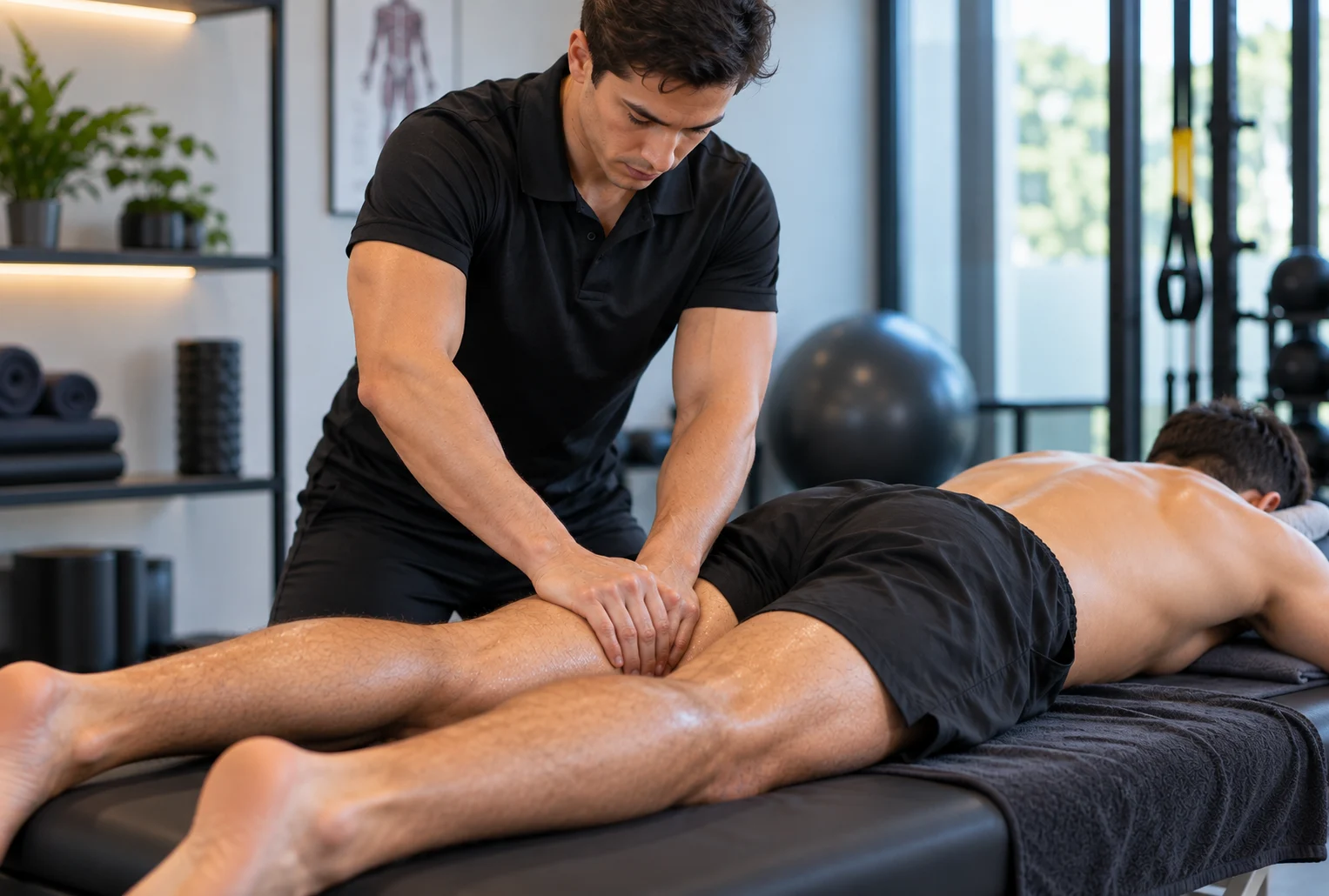
It is a targeted manual therapy that addresses the specific demands placed on muscles, tendons, and connective tissue by physical training. It differs from a relaxation massage in both intent and technique, where the practitioner works with an understanding of load, movement patterns, and where compensation tends to build up in an active body.
A relaxation massage helps to calm a person down for an hour but sports massage has a different focus: what is the body compensating for, and what happens if it keeps compensating. That distinction shapes everything about how the session is planned and delivered.
In practice, this means firmer, more targeted work on specific muscle groups, techniques drawn from clinical soft-tissue therapy, and an approach that changes depending on where someone sits in their training cycle. A session before a race looks different to one during a heavy strength phase.
Why Athletes and Active Professionals Turn to Sports Massage?
Training creates microscopic damage in muscle tissue. It’s normal and that is how adaptation works. Muscles rebuild stronger after the stress of training, provided recovery keeps pace with load.
The trouble starts when recovery doesn’t keep pace. Tight fascia restricts blood flow. Overworked muscle groups start recruiting neighbouring ones to compensate. Range of motion narrows, often without the person noticing until a movement that used to feel effortless starts to feel effortful.
Sports massage for athletes addresses this directly, working through soft tissue to encourage circulation, reduce localised tension, and support the body’s own repair processes. For professionals training around long desk hours or travel schedules rather than a formal sport, the underlying mechanism is the same: unaddressed tension compounds, and manual therapy interrupts that build-up before it changes how someone moves.
Breaking Down the Core Benefits
The value tends to fall into three overlapping categories. They rarely operate in isolation.
For Recovery
Between sessions, the body needs more than rest; it needs support for the repair work already underway. Sports recovery massage contributes to this by:
- Encouraging blood flow to fatigued muscle groups
- Reducing the density of tight or knotted tissue
- Supporting the nervous system’s shift out of a stressed, high-alert state
- Shortening the window between hard sessions without compounding fatigue
For Performance
Mobility and mechanics underpin performance more than most training plans account for. A joint that can’t move through its full range forces compensation elsewhere in the chain, and compensation is expensive over a season. Among the clearest sports massage benefits for a serious trainer is the mobility it protects long before an injury forces the issue.
Regular sessions support the range of motion needed for clean, efficient movement. Runners maintain hip and calf mobility. Lifters protect shoulder and hip mechanics under load. Desk-bound executives training for their first triathlon rebuild the flexibility a decade at a screen has quietly taken from them.
For Injury Prevention
This is where the benefits of sports massage matter most and get discussed least. A skilled practitioner notices asymmetries and restrictions before they become symptomatic. Catching these patterns early is materially different to treating an injury after it happens. One is a conversation about mobility. The other is a conversation about time off training.
How Sports Massage Fits Into a Clinician-Guided Recovery Plan
A generic massage is a single, standalone service. You book it, you receive it, and the next decision is entirely yours to make with no clinical input. While at RAPIDÉ, your condition is carefully assessed by medical professionals and prescribed according to what you need.
Every client begins with an assessment. A clinician reviews movement patterns, training history, and current physical status before recommending anything. If it’s indicated, the treatment is positioned within a broader recovery or performance plan, sometimes alongside physiotherapy, or a structured mobility programme, depending on what the assessment reveals.
This matters because tightness in one area is often a downstream symptom of a restriction somewhere else entirely. Treating the symptom without identifying the cause offers short-term relief and little else. A clinician-guided plan treats the pattern, not just the point of pain.
The result is a plan that’s measured against progress, not just booked on a whim. Sessions are reviewed, adjusted, and integrated with whatever else the plan calls for: a reformer Pilates block to rebuild control, a strength programme to address the underlying weakness, or simply a considered frequency that matches actual training load rather than guesswork.
What to Expect During a Session at RAPIDÉ
The session opens with a brief check-in on how the body has responded since the last assessment or the last block of training.From there, the practitioner works with intention through the areas the clinical review has flagged, adjusting pressure and technique based on what the tissue tells them, not a fixed routine repeated regardless of the person on the table.
Sessions are private, unhurried, and structured around the individual’s current protocol. Some clients leave with a specific set of mobility exercises to reinforce the work. Others are advised on load management for the coming week. The session is one point in a longer, considered plan, not an isolated hour disconnected from everything around it.
Who Should Consider This, and How Often
A common assumption is that this kind of therapy exists only for elite athletes deep into a competitive season. It doesn’t.
Anyone placing sustained physical demand on their body benefits from having that demand assessed and supported: competitive athletes managing training cycles, weekend runners building toward a first half marathon, and executives whose only consistent movement each week is a gym session squeezed between meetings.
Frequency isn’t fixed. It depends on training load, recovery capacity, and what an assessment identifies as necessary, which is precisely why RAPIDÉ starts every relationship with a clinical review rather than a standard booking calendar. A protocol suited to marathon training in its final weeks looks nothing like one suited to general mobility maintenance for someone training three times a week.
A Longer View of Recovery
Sports massage isn’t a fix for a single tight muscle. When used well, it’s a recurring, clinically informed check on how the body is genuinely holding up against everything asked of it.That’s the distinction worth sitting with: not what a single session feels like, but what a well-structured recovery protocol does for a body over years of training. RAPIDÉ’s approach starts with an assessment, not an appointment slot, because the two produce very different outcomes over time.
If tightness, restricted mobility, or a nagging pattern in how you move has been sitting unaddressed, an assessment is the sensible next step. Book an appointment with RAPIDÉ and find out what your body is asking for.
FAQs
It can feel firm in areas of genuine tightness, but a well-delivered session should never cross into sharp pain. Pressure should be calibrated to what the clinical assessment shows, not applied at a fixed intensity regardless of the person on the table. Discomfort that lingers well after a session is worth flagging to your clinician.
Frequency depends on training load, recovery capacity, and what stage of a training cycle you’re in. Set frequency through an assessment rather than a fixed package. Someone in a heavy marathon block will need a different rhythm compared to someone maintaining general mobility.
A regular or relaxation massage is built around comfort and calm. This one is built around how the body is being used: it targets the muscle groups and movement patterns specific to a person’s training, sport, or physical demands, using firmer, more targeted techniques than a spa-style session.
No. Anyone under sustained physical demand, whether from competitive training, weekend sport, or long hours at a desk followed by irregular gym sessions, can benefit from having that demand assessed and addressed.
Every new client begins with a clinical assessment rather than going straight to the massage table. A clinician reviews movement patterns and training history first, then recommends whether this treatment, and what frequency, fits the person’s current needs.
